Leading the Herd
Author
In the spring of 2025, Caitlin and Jason Keck completed their term on the American Farm Bureau Federation’s (AFBF) Young Farmers & Ranchers (YF&R) Committee. During their two years on the committee, they helped plan and run the AFBF Annual Convention, the YF&R Leadership Conference and FUSION Conference. It also gave them the opportunity to connect with other farmers and ranchers across the country and serve as representatives of their peers.
“One thing that really sticks out is our relationships,” Jason says. “The amount of people that we know in the state and across the nation now—there’s not a question I have that I can’t text somebody and say, ‘Tell me about this.’ It’s been amazing.”
Rachael Peterson, Minnesota Farm Bureau Federation’s (MFBF) leadership coordinator, says through the YF&R program, “Our goal is to empower our members of those younger ages [18-35] to know that their voice and their experiences are valuable to our organization. We do that through programs … so they can gain leadership development experiences and a stronger network, and so they can grow personally an professionally.”
That’s certainly been the case for the Kecks. The couple met in high school and both competed in the Farm Bureau FFA Discussion Meet, and they have been involved with MFBF and the YF&R program ever since. Caitlin officially became a member in college while serving as state FFA secretary.
Though the couple lived out of state for several years after graduating college and getting married, they returned to their hometown of Owatonna in 2015 and got plugged into the Steele County Farm Bureau. Caitlin joined the county board in 2016 and continues to serve on it, and Jason joined the county board last year. In 2019, the couple was recruited to the Minnesota state YF&R Committee, which they served on together for three years. Following that term, they were recruited to serve on the National YF&R Committee, the term that wrapped up earlier this year.
“Busy” doesn’t begin to describe the Kecks. They have three young kids at home, Jason farms full-time with his father and uncle, and Caitlin works full-time as the senior director of stakeholder communications at the National Pork Board and grows produce and runs operations for the direct-to-consumer part of their farm. That means their YF&R terms represented a serious time commitment—but they’re both grateful for what the experiences gave them.
“We listened to the advice of other people and asked them about their experience,” Caitlin says, “and everyone told us, whether they were from our state or different states, ‘It’s a time commitment, but it’s totally worth it. You’ll make connections with farmers across the country, and that network is so valuable.’ So, we listened to their advice, and we would echo those same words of advice to other people.”
Contests and Committees
Participation in YF&R competitions—most notably the Discussion Meet—is a common way young adults get involved with MFBF. Chippewa County Farm Bureau member Megan Horsager was the 2024 Minnesota YF&R Discussion Meet winner, which meant she progressed to the national YF&R Discussion Meet.
“Farm Bureau is a way to continue to be in leadership positions and using and growing [speaking and leadership] skills,” Horsager says.
Designed to simulate a committee meeting, Discussion Meet participants discuss a selected topic and must come up with ideas and decide on a course of action. They’re judged based on their knowledge of the topic, their cooperation and communication throughout the discussion, and their ability to analyze the problem and develop solutions. 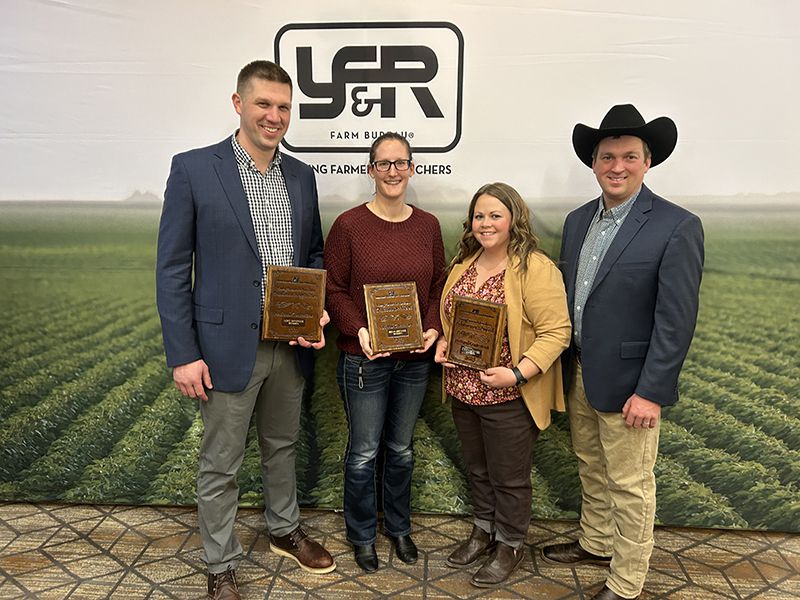
The first round of Discussion Meet competition takes place at MFBF’s Leadership, Education, Advocacy and Promotion (LEAP) Conference in January each year. The top eight competitors progress to the finals at the MFBF annual meeting in November. The state winner advances to the national competition, held at the AFBF annual meeting, where each state can have one representative.
“The people who do really well just have lots of life experience,” Horsager says. “These are all topics that relate to farming.”
The way she prepares for a Discussion Meet is simply doing her job as a farmer: “I’m going to meetings. I’m constantly doing continuing education as a farmer and reading magazines and articles and staying up to date with what’s going on [in the industry] and having discussion around the family table,” she says.
Beyond competitions, Horsager has also gotten more deeply involved with MFBF through volunteer opportunities. Four years ago, when she moved back to Minnesota to work on her family’s farm after working as a chemist for several years, Horsager joined her county board. About two years ago, she also became a district representative on the state YF&R committee, which is a three-year term. This fall, she became state chair of the YF&R committee, a year-long post.
She’s the second in her family to hold this role. “My dad was chair of the board when I was young,” Horsager says, “so it’s always been in the back of my mind: If I’m farming, this is a good organization, and this is an accessible way to participate as a young farmer.”
Collegiate Programs Spur Involvement
As a YF&R district representative, Horsager helps plan and organize a collegiate Discussion Meet and summit meeting in her district. On the state board, she collaborates with other YF&R district representatives to plan the LEAP Conference alongside the Promotion & Education Committee, as well as promoting the YF&R contests. This year, as board chair, she’ll sit on the state Farm Bureau board to represent YF&R.
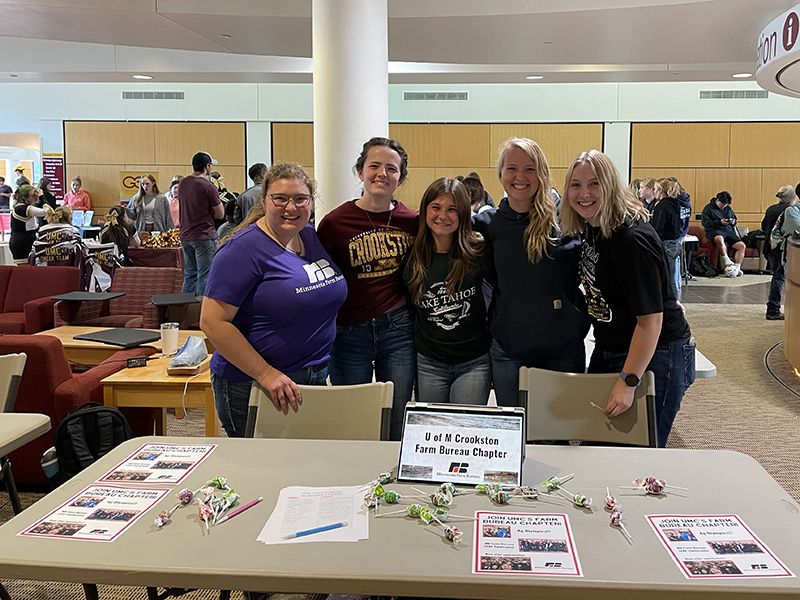 College is a key recruitment channel. A couple years ago, Kayla Mistic, MFBF’s Northwest Area Membership and Marketing Specialist, was looking for a way to introduce young, up-and-coming members of the agricultural community to the Farm Bureau organization. The Collegiate Discussion Meet was one way for college students to get involved with YF&R, but Mistic had visions of establishing an official collegiate chapter of YF&R to foster even more engagement and opportunities. That’s when she got connected with Lily Krona in 2023.
Krona, then a sophomore at the University of Minnesota Crookston, was pursuing a degree in agriculture education after being deeply involved in 4-H growing up. She had recently become a West Polk County Farm Bureau member and attended the LEAP Conference. Mistic invited Krona and some of her friends to attend a county Farm Bureau meeting and asked them to help formulate some ideas for how to start a collegiate chapter of YF&R on their campus. Their conversations took off, and what had started as a five-year plan came to life in a mere three weeks, launching in May 2023.
Krona served as Crookston’s collegiate chapter president from 2023–25, where she ran meetings and helped plan events—including Ag Olympics, which has become a hugely popular event on campus. She helped facilitate a YF&R Collegiate Discussion Meet and held mock meetings on campus to help participants prepare for it. During that time, she also participated in The Herd, a year-long program for MFBF members ages 18–23 that focuses on agriculture communications through social media.
Today, the collegiate chapter regularly has 15 to 20 students at each meeting. Though Krona is no longer involved—she graduated college in May 2025 and now teaches ag education in the Crookston school district—she continues to encourage others to get involved. And she’s continuing her involvement with YF&R as a new board member for the West Polk County Farm Bureau.
More Than Just Resume Skills
The benefits for YF&R participants aren’t just about the competitions and the formal volunteer roles. The long-term rewards are the relationships they forge and how they grow in their leadership, advocacy and communication skills.
For Krona, participating in YF&R activities and being involved with her county Farm Bureau have helped her grow in confidence and brought much-appreciated support as she’s stepped into her career this past year. “It gives a lot of resources for me as a teacher, especially to have a lot of ag connections that I can talk to different people about new things to try in my classes or [bring in] guest speakers,” she says.
Reflecting on her collegiate YF&R experience, Krona says, “I gained so many skills. Verbal communication skills through the Discussion Meet are a huge one, but also media presence through The Herd. As president of the Collegiate Farm Bureau, I learned a lot of leadership skills on how to lead successfully and make sure everybody has a voice and opinion on what we’re doing.
“I love going to meetings and meeting new people,” Krona adds. “I used to be so shy when I started 4-H, and then over the years, you just get pushed to ask questions and meet new people. Now, going to different meetings—I’ve gone to a few meetings by myself and I’m nervous to go in, but then once I get in there, I realize that everybody’s helpful and supportive.”
The Kecks appreciate the long-term benefits, too. Aside from the relationships they’ve formed through their YF&R involvement, Jason says his participation on MFBF and YF&R committees has given him the opportunity to participate in the advocacy side of the organization, helping develop new skills and interests. “It’s being able to see that full circle,” he says, “coming from a high school kid who didn’t want to be involved with much of anything to working through our state and national level and really seeing the power that brings to the American farmer.”
On Horsager’s part, she says YF&R has enabled her to forge deeper relationships with other farmers—whether it’s having peers and mentors she can call with questions, getting advice and insight when implementing something new on her farm, or simply having friendships with other farmers who understand what she’s going through.
“Friendship and connection—it’s something I think everybody struggles with across industries in our world today,” Horsager says. “But Farm Bureau is a place to find community. It’s a place to find like-minded individuals. It’s a place to learn and grow in community, and I think that’s what has made it so valuable and helped me so much: the connections, and then the connections leading to opportunities and genuine friendship.”
Involvement Begins Early
While the YF&R program is technically for young adults ages 18–35, MFBF partners with youth organizations FFA and 4-H to offer leadership training and scholarship opportunities to teens.
“We start even before the age of 18, working with a couple of different youth agriculture programs in the state, specifically 4-H and FFA,” says Rachael Peterson, MFBF’s leadership coordinator. “We do leadership training with some of their student and member leadership. They are such impressive individuals … we see so much potential that we want them to stay involved.”
Cole Sundeen, a Wright County Farm Bureau member, was invited to participate in YF&R activities when he was in high school. He didn’t grow up on a farm, but he got involved in FFA in junior high, which introduced him to MFBF and the opportunities available through YF&R.
“In my sophomore year, my agriculture teacher, Mr. Ramstad, was pretty involved in Minnesota Farm Bureau,” Sundeen says. “He encouraged me to join the Farm Bureau FFA Discussion Meet, and that’s really where I started my involvement with the Minnesota Farm Bureau.”
These experiences also led him to the career path he hopes to pursue. Sundeen is a sophomore at the University of Minnesota Crookston, where he is majoring in agriculture education—and he’s a member of the collegiate YF&R chapter at Crookston.
“I hope to be an ag teacher one day, teaching students about agriculture and inspiring them in their FFA and leadership journeys,” he says.
It Starts with a Question
For many Young Farmers & Ranchers (YF&R) participants, getting involved came from an invitation from someone else. “We’ve had a lot of encouragement,” says Caitlin Keck, Steele County Farm Bureau board member. “I think that’s what people can expect from Farm Bureau: You will get a community of people encouraging you to try new things and to say yes to things that might be uncomfortable or new to you.”
That certainly held true for Megan Horsager, the chair of the state YF&R Committee. “Most of the reason I’m in the role I am right now is because there was a need and someone asked me to do it,” she says. “I want to be able to fill the gaps as much as I am able … I just hope to be able to continue to serve where it is needed and when it makes sense.”
YF&R Competitions
Aside from the Discussion Meet, there are two other annual YF&R competitions:
Excellence in Agriculture Award
This award recognizes participants whose primary income is derived off the farm for their involvement in agriculture, leadership ability, and participation in Farm Bureau and other organizations.
Achievement Award
This award highlights efforts in production farming and leadership achievement. Contestants are evaluated on farming operation growth and financial progress of their operation, and leadership within and outside of Farm Bureau.