Seeds of Sustainability
Author
The Lower Sioux Indian Community is on a mission to get its members into healthier homes. Since 2016, the indigenous community, located in Morton, Minnesota, has been growing the main material necessary to build affordable, sustainable homes right on the reservation: hemp.
“You can grow your home right in your community and teach your people how to build with those materials. You give them jobs; you give them homes,” says Danny Desjarlais, the Lower Sioux’s industrial hemp construction project manager. “Our goal is just trying to rebuild our community but also maybe inspire others to do the same for their communities.”
A Complicated History
Not many people know hemp can be grown and used for building homes, among a multitude of other purposes—55,000 and counting, according to Joey Goodthunder, a farmer for the Lower Sioux. While it’s not as widely farmed today, industrial hemp has been part of U.S. agriculture for centuries, even before the U.S. became its own country.
 After taking root overseas in China and Europe, hemp was brought to New England by the Puritans in 1645, where they used it as a fiber source for household spinning and weaving. The hemp industry continued to spread to states like Virginia, Kentucky, Missouri and Illinois, thanks in part to the U.S. Navy’s strong demand for sailcloth and cordage between 1840 and 1860.
“Hemp is what America was built off of,” Desjarlais says. “I tell a lot of people, ‘If you’re a farmer and you have farming somewhere down the line, they were probably hemp farmers. Hemp farming is in your blood if you’re an American farmer.’”
As part of the cannabis family, hemp has had a rocky relationship with the U.S. government. In 1937, Congress passed the Marijuana Tax Act, which required the registration and licensing of all hemp growers with the federal government to restrict the production of marijuana. While this act was aimed at stopping recreational drug users, it also affected the industrial hemp industry, making hemp production less economical.
Then, during World War II, when cheaper hemp alternatives like jute and abaca were unable to be imported, the government instituted an emergency program, called Hemp for Victory, to encourage farmers to produce hemp domestically.
By 1970, however, the Controlled Substances Act (CSA) criminalized the manufacture, distribution and possession of all varieties of cannabis, including hemp. It wasn’t until the 2018 Farm Bill that hemp was removed from the CSA list, allowing hemp with a tetrahydrocannabinol (THC, the psychoactive component of marijuana) concentration of less than 0.3% to be produced for industrial purposes.
Hemp for Homes
For the Lower Sioux Indian Community, growing hemp starts with finding the right variety. “We want one with more hurd in it,” explains Goodthunder. Hurd is the woody, cellulose-rich core of the stalk, a key component for making building materials out of hemp.
Once Goodthunder finds the seed he wants to use, he and his team plant it in mid-April or early May and grow it for 90 days. “Then we come out and cut it and let it ret for three to five weeks,” he adds. “Retting is just a fancy word for rotting out in the field. It’s basically decomposing the glue off the fiber so we can process it for the hurd that we’ll use to build houses.”
The hemp is then round baled and hauled to the Lower Sioux's new processing facility, a $2.3 million project that was completed last year. Desjarlais and Goodthunder are hopeful that the 10,000-square-foot facility will eventually help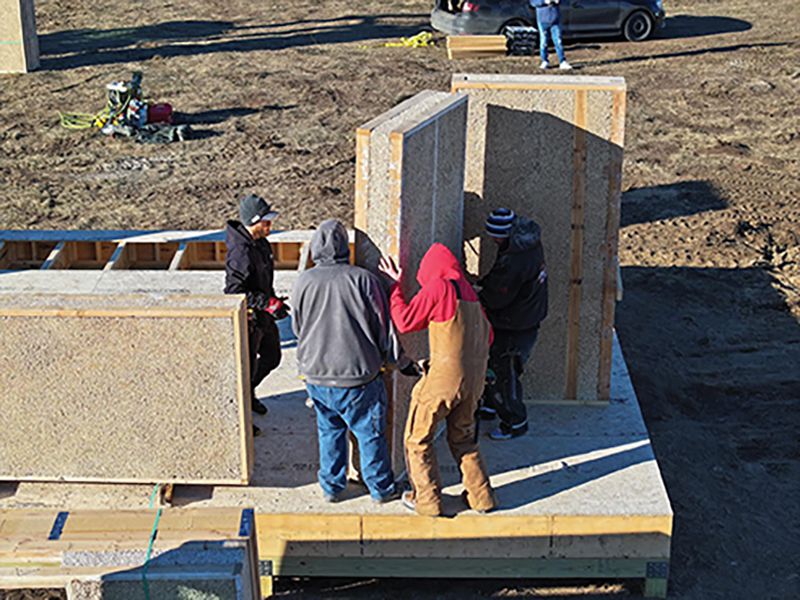 them produce enough hemp building materials to close the housing gap on the reservation. Desjarlais says the community is about 200 homes short of adequately housing its members, referring to recent data from the U.S. Department of Housing and Urban Development. “We do have a big need for homes,” he says. “There is a lot of overcrowding and a lot of multigenerational living.”
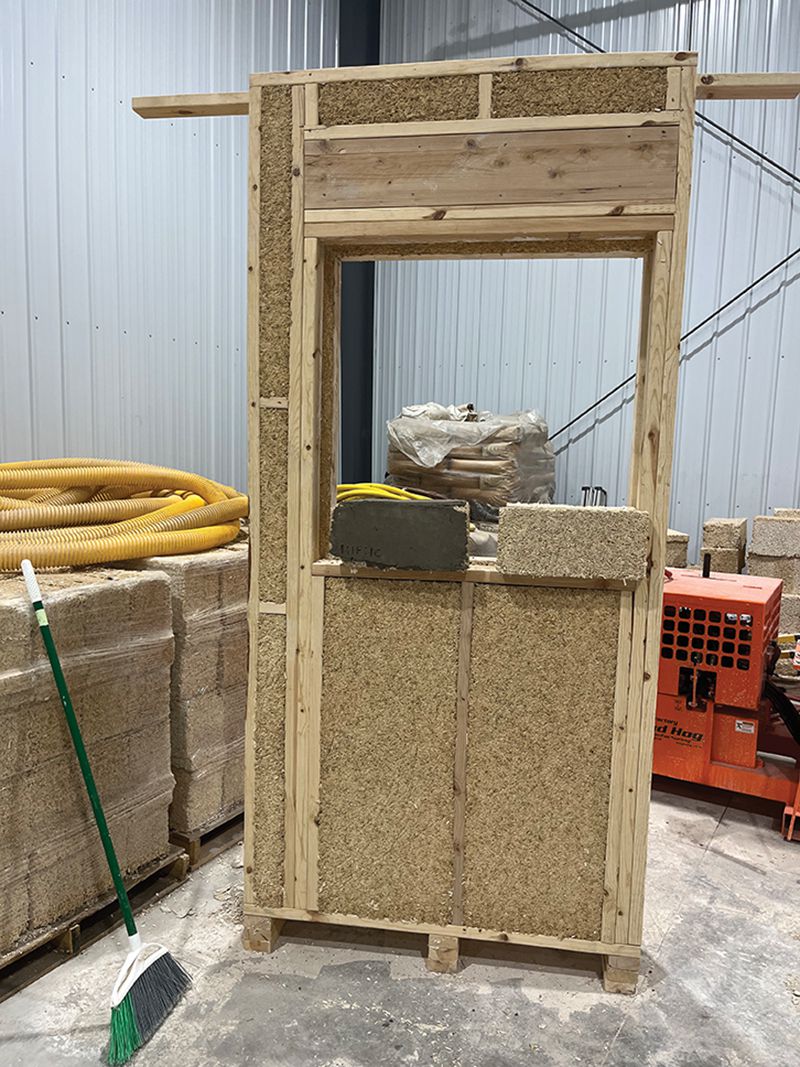
After the hemp is brought to the processing facility, it’s mixed with lime and water to form hempcrete, a lightweight insulating material that is a cost-effective, natural and sustainable alternative to fiberglass insulation. On average, it takes about 10,000 pounds of hemp to build a 1,500-square-foot home. The facility has the capacity to process up to 2,500 acres of hemp, a number the reservation can’t fulfill with its own land. Down the road, Desjarlais wants the Lower Sioux to partner with farmers in the area to grow hemp in exchange for a profit. “It doesn’t have to be an indigenous community,” Desjarlais says. “There are tons of farmers right now that are struggling. I think this could help alleviate some of that.”
To date, the Lower Sioux have used hempcrete to build five homes, most of which are on the reservation. With Minnesota on track to become the first state to put hemp and straw in its residential building code, hempcrete homes will become more accessible to people off the reservation as well.
“Being on tribal land, we didn’t have to deal with any building codes, so that gave us a head start to be able to begin building,” Desjarlais says. “They’re just livable homes for our community members. I think that’s what sets us apart in the hemp building space. Almost all of the hempcrete homes or structures in the country are owned by rich people—they’re like mini mansions. We’re just trying to put our members into homes that are healthier.”
Made from all-natural materials, hempcrete is a healthier alternative to today’s conventional building products, most of which are made with plastics. This is better not only for the people who live in hempcrete homes but also for the environment.
As the hemp grows, it improves soil quality due to its deep root system, which enhances water infiltration and absorbs heavy metals. Its dense, hardy foliage, which can withstand extreme weather conditions, forms a canopy to protect soil from erosion and creates a nutrient-rich topsoil with fewer pesticides and fertilizers. “We have one field that had hemp on it for three years in a row,” Goodthunder says. “We put corn on there, and it’s our best-looking corn we have.”
Hemp also sequesters carbon as it grows, a benefit that continues even after the hemp is harvested and processed. “Once you build your structure, it’s still pulling carbon out of the air. There isn’t another building material on the planet that does that,” says Desjarlais, noting that hempcrete outperforms conventional insulation by 30% to 70%, saving money on energy costs. “It’s making it affordable for people to live in these homes because they can afford to operate the home. We’re creating affordable housing that is actually affordable.”
Since it can be grown locally, hemp is also economically beneficial. It’s free from tariffs and can create jobs in the community. “It sounds too good to be true,” Desjarlais says.
The Future of Hempcrete
While the Lower Sioux have been focused on building homes for their own community up to this point, they are hoping to expand their hempcrete production to others outside of the reservation once hempcrete is added to the Minnesota building code.
“Right now, it’s more of a movement than a business model,” Desjarlais says. “It’s a great movement, don’t get me wrong—I think one of the greatest things you can do is try to rebuild your community. But you also need to make money to keep that going.”
Desjarlais’s plan is to create prefabricated hempcrete panels in the tribe’s facility for model homes, where those interested in building a hempcrete home could choose from a variety of floorplans. “We would have those panels ready, set them on a trailer, and send them to wherever they need to go,” says Desjarlais, who adds that there has already been some interest from economic development groups outside of the reservation.
The next step in making that vision a reality is improving processing. “That’s really where the bottleneck is,” Desjarlais says. “I think the more farmers that start [growing hemp] here in the U.S., the better the processing will get. There’s a lot of farmers out there who might have solutions to get the processing really streamlined. Without the processing, you really don’t have anything.”
Goodthunder and Desjarlais are looking to other countries to see how their hempcrete processing works, but a solution may be on the horizon closer to home, too. U.S. Senator Amy Klobuchar recently secured $1 million in federal funding, $500,000 of which will be allocated to research on industrial hemp fiber, to support Minnesota hemp growers and processors.
“The education and awareness of getting it out there is really what we’re missing,” Desjarlais says. “We have farmers. We have builders in this country. It’s just they don’t even know this thing exists. If we do get the right processing equipment, there’s so much stuff we could process the seed for.”
He points to examples like clothing and animal feed, which would create a significant income stream for farmers interested in growing hemp. “We’re just scratching the surface. There’s so much potential."