Farm Transitions: Maintaining a Legacy
Author
For Paul and Ruth Lanoue, taking over a family farm was an unexpected opportunity. While both came from multigenerational farming families in Lyon County, Paul’s family farm didn’t have the capacity for him to get involved, and Ruth’s was intended to be inherited by her brother.
They left their hometowns for a number of years, Paul pursuing a degree and career in agriculture education, while Ruth studied nursing and became an RN. When the couple eventually moved back to Marshall, they purchased a property with a small hobby farm three miles from Ruth’s parents’ house.
At that point, it was becoming apparent that Ruth’s brother wasn’t going to be able to farm due to medical concerns that brought physical limitations.
“My father-in-law [Pat] said, ‘It’s kind of sad that nobody’s going to be able to take over our farm,’” Paul recalls, “and I was like, ‘Yeah, it doesn't look like there’s going to be much capacity for me within my family farm.’ We both looked at each other like, ‘Wait, what if we work together?’”
The transition begins
Paul brought a couple of old cows over from his family farm and started farming cattle with Pat. As Paul continued to get more involved with the farm, it was decided that Paul and Ruth would swap houses with Ruth’s parents, allowing Paul and Ruth’s seven children—ranging in age from 4 to 21—to participate in farm life as well.
“Ruth says, ‘The best way to get something in your blood is to get it on your hands’ and just be immersed in it,” Paul says. “Our kids are involved in the farm. They can see it and they can grow it as part of their passion as well. [If they didn’t] live here, then they wouldn’t be involved in the day to day.” 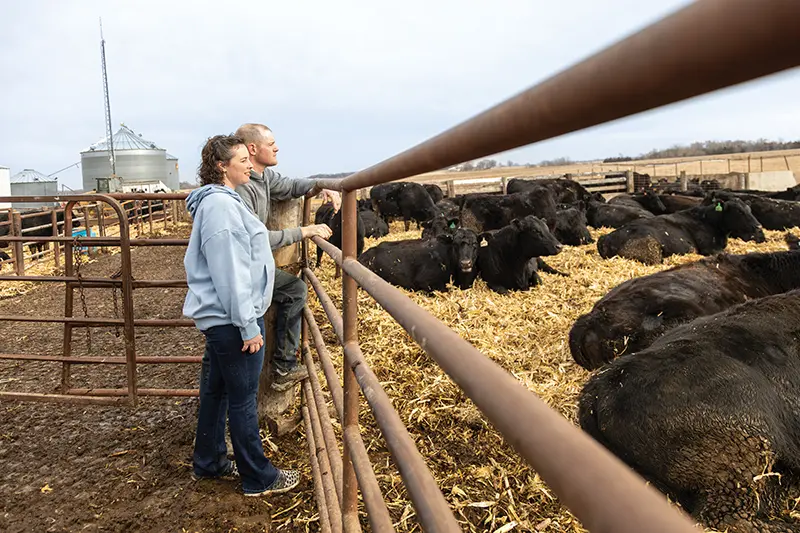
But with the couple’s move to the home farm, it was time to reevaluate the estate plan. When Ruth’s dad and uncle first started their farming partnership, they owned everything 50/50, down to their houses—meaning when Ruth’s uncle passes away, his kids would technically own a percentage of Paul and Ruth’s home. The family also had to figure out a plan to transition the ownership of cattle and crops, which are held in LLCs and shared among a handful of family members.
Off the farm, Paul worked as a farm business management instructor for Minnesota West Community and Technical College, where he later served as dean. That experience gave Paul a deep understanding of how to navigate the often-stressful process of passing a farm from one generation to the next.
“The reality is, I didn’t want to make that jump from professional to farming without a plan and structure in place,” says Paul. “I needed to have a vision and a plan, so that I could see that there was an outcome in the future for me and my own family. I know that the legacy of farming is super important and what I want to carry on for our kids, and at the same time, I can’t sacrifice our family for it.
“There are a lot of emotions, and the shift of power is major,” he adds. “The transition of money, the transition of management and the transition of decision making takes time and practice. It won’t be done perfectly, it won’t be done easily and it won’t be done without stress.”
Prepping for a smooth handover
Nathan Hulinsky, a University of Minnesota Extension associate professor, says the questions about farm transitions that he hears most frequently from farmers center on how to sell the assets to their kids. Those are fair questions, he says, “but in all honesty, the farm needs to focus on transferring the farm management [and] the farm income over time before we even start talking about transferring assets.
“I’ve had conversations all too often with farm families where they gave everything to the son or daughter [...] but that person didn’t know how to properly manage the farm and run a business, and then they weren’t able to keep the farm running.”
Hulinsky says once you have determined who will be the successor and there’s a solid plan in place to train them to take over the farm, you can start thinking about how to divide the assets.
“You need to look at what’s fair versus equal among your children,” he says. “A lot of parents want to say, ‘I have four kids. Each of them gets 25% of my assets.’ That’s equal, but if the on-farm child was working for minimum wage for the last 10, 15 years building sweat equity on the farm, they probably deserve more than a 25% share of the parent’s assets.”
In the farm transition and estate planning workshops Hulinsky hosts around the state, he walks through these types of scenarios. He also helps farmers understand transition strategies, learn about tax issues in the transition process and identify a transition and estate planning team.
“My goal at the end of these workshops is for those farm families to go home and determine what their goals are, and then communicate those goals with the family members,” Hulinsky says. “Breaking down why you are breaking up your assets this way is typically helpful to the children, rather than just being blindsided when the will is being read.”
Navigating power transitions
Oftentimes, getting a farm transition plan on paper isn’t the hard part—it’s the transfer of decision-making and power, says Paul, noting what he observed as a farm business management teacher.
“I would tell farmers, ‘Within seven years, your kid needs to be making a part of the business decisions independently, otherwise they’ll always be looking for somebody else to make those decisions for them. They need to have some of that autonomy.’”
Within the Lanoue family operation, that has meant Paul taking more ownership of their cow-calf operation, both in the day-to-day care and long-term decision making. The farm is already seeing the benefits of Paul’s leadership. He’s doubled the number of cows on the farm and improved the quality of the herd through genetics and record keeping.
“Taking care of the cows is something that I’ve taken a lot of pride in,” Paul says.
He notes that, as with any major business transition, it’s important to remember that the passing of a farm operation from one generation to the next won’t happen overnight. Even though much of the farm work has been handed off to Paul, Ruth’s dad Pat is still actively involved in daily operations. This gives Pat the opportunity to slowly phase out his involvement while keeping in touch with agriculture and working alongside his grandkids.
Lessons along the way
Despite the challenges that a farm transition can present, Paul and Ruth wouldn’t change anything about their experience, because “it helps form where we’re at today, and I like where we’re at today,” Paul says. “It hasn’t been perfect, but the journey right now is feeling good.”
“Has there also been growth? Absolutely,” Ruth adds. “As you come up on the other side [of a transition], I think that there are lessons that we all learn in ourselves and how to work with others.”
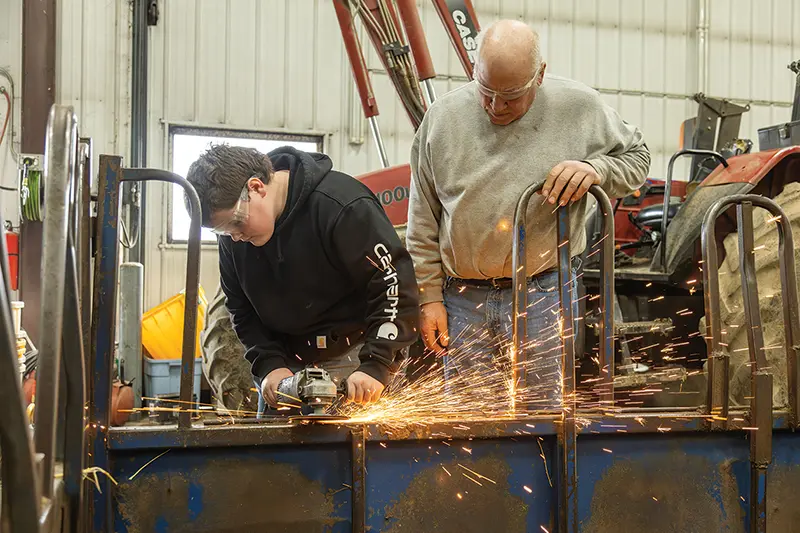 One of the biggest takeaways from their experience is how to handle the next transition when it’s time for Paul and Ruth’s kids to take over the farm. They’re encouraging their kids to explore different agriculture skillsets that interest them, and they’ve already started allowing them to make some of the decisions on the farm.
“We’re trying to find ways to get them involved already and help them have some buy-in to the farm as well,” says Paul. “I’m seeking their input. I allow them the opportunity to make some decisions and realize their decision may not be the same as mine or how I would go about it. But that’s OK to learn from it and maybe see something different to allow them to grow. Our kids see that they have a part, they have a role, and that they’re valued and important to our farm.”
For Paul, the most important lesson that came out of the farm transition process was recognizing when he reached his limit and needed to make a change.
In 2021, he had an emotional break. “I was burning the candle at both ends, with a blow torch in the middle,” he says. “Something needed to give.”
Paul decided to leave his position as dean of the college to work on the farm full-time. Seeing what he went through inspired Ruth to create Fenceline (fenceline.life), an online community where farmers can connect and share their struggles, fostering emotional health.
Paul says that, for many farmers, the mindset is, “You can’t breathe a word of weakness to your neighbors, otherwise they’ll gobble you up, and so we isolate.”
Naturally, that has ripple effects. “The level of suicide and substance abuse is insane in the agricultural community,” Paul adds. “So, we’re creating an online group for people to communicate some of these things together. Mental health is important, because otherwise, the farm can’t succeed. There needs to be an outlet. There’s an emotional component that is so incredibly stressful.”
In addition to Fenceline, which is still in the early stages of development, Ruth works as a home health nurse one night a week, and the couple owns a handful of investment properties they enjoy renovating and running as Airbnbs.
“I see it as a blessing to be able to do the things that I love, to be involved in a cattle farm that’s successful, to engage in agriculture and have the opportunity to make some of those decisions, and to see where our farm has grown during the time I’ve been involved,” says Paul. “There’s hope for our farm, and there’s hope for the future.”
4 Tools for a Smooth Farm Transition
If you’re getting ready to hand your farm over to the next generation, these resources can help simplify the process.
- Talk with your Farm Bureau Financial Services representative, who can help with estate and succession planning and connect you with other resources and planning experts you might need during the transition process.
- Attend a farm transition and estate planning workshop or seminar, such as those hosted by Farm Bureau or University of Minnesota Extension. “That’s the best way for farmers to hear all the information,” says Nathan Hulinsky, an Extension associate professor. “We will talk about a topic and then have breakout times for the family to discuss their thoughts on that topic.”
- Build a team of trusted advisors who will help you through the transition process. This should include your lending institution representative, an attorney, a tax accountant and the heirs to the farm. “Build trust with those professionals who have that experience,” says Paul Lanoue, a farmer and former farm business management instructor. “Having people on your team is critically important to keep the dialogue moving in a positive direction.”
- If you don’t have an heir to pass your farm to, post your property on Minnesota Farm Link, a site for farmers who are looking to transition their farm to new ownership.
Find Support Among Your Peers
Ruth Lanoue’s online community, Fenceline, is a resource for farmers to share thoughts and feelings and find support. Visit it at fenceline.life.
From the Ground Up
How one couple determined to make a career out of farming grew their first-generation cow-calf ranch into a thriving business.
Dylan and Shelby Radke knew they wanted to pursue a career in farming after graduating from college, but with no farmland for either of them to inherit, they had to start from scratch.
After the couple got married, they purchased their first property in 2014—a 25-acre ranch in Beltrami County—and soon began building their herd with 18 bred cows. 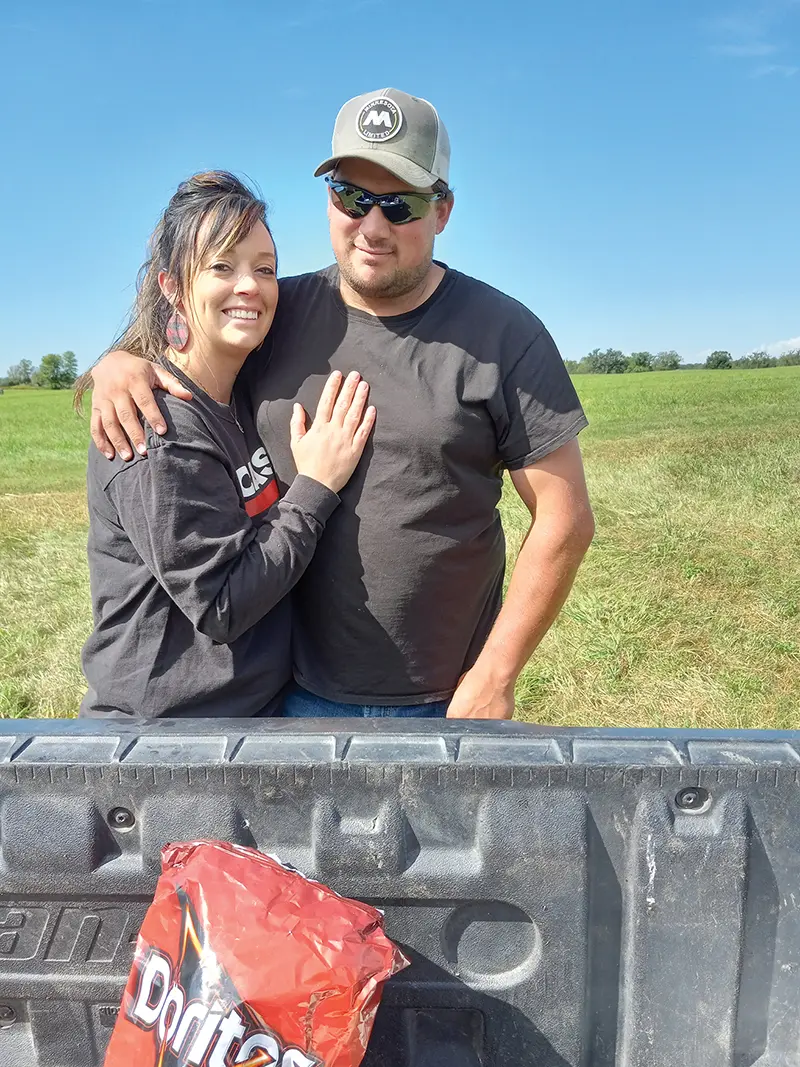
“We didn’t have a lot of infrastructure, which was a big challenge,” Shelby says. “Calving out that 18 head of cows our first year, we didn’t have a chute, we didn’t have a calving pen to get them into. We had to tie them to a pole in the barn that we did have. We had just one tiny tractor that wouldn’t start because it was so cold out, but we had to feed the cows. So, we just had to do things creatively.”
With little to offer as collateral when they first started farming, it took a couple of attempts to secure a loan from an ag bank. But year after year, the Radkes slowly grew their herd and made investments in their ranch as finances allowed.
“Looking back and seeing how much we’ve grown and how far we’ve come is rewarding,” says Dylan. “Now, we look back and laugh at some of the things that we struggled with.”
A big turning point came in 2020, when Dylan and Shelby were able to purchase another ranch just down the road. Complete with more buildings and equipment like a chute and catch pen, the new ranch gave them the space to buy more cattle and triple their herd size.
Today, the Radkes operate their Black Angus cow-calf ranch with 120 cows. They also manage a direct-to-consumer beef business and offer carriage and sleigh rides with their team of draft horses. While both still have off-farm jobs—Dylan in road construction and Shelby as a nurse at the VA clinic—they are hoping to eventually work full-time on the farm with their two kids, an 8-year-old boy and a 5-year-old girl.
Last November, the Radkes were named winners of the 2025 Minnesota Farm Bureau Federation Young Farmers & Ranchers Achievement Award for the growth of their farming operation and leadership positions within and outside of Farm Bureau.
“We love what we do,” Shelby says. “When we have people come out on the ranch or we’re talking to people about it, hearing how excited they get and the questions they ask—just seeing it through other people’s eyes makes you feel proud, because we did this. We did go through struggles, but now we can see what we have. We just keep making new goals. Every time we reach our goal, we make new goals and something to work toward.”